

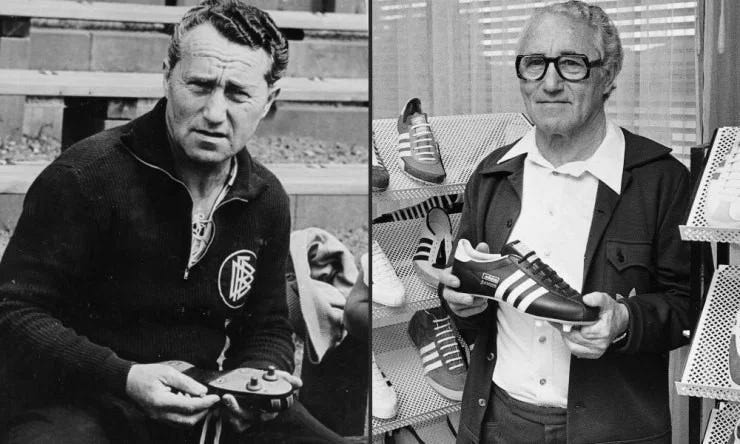
My old man is a bit of a football nerd—the European kind. He can definitely kick a ball around. Great technique, soft touch, but can’t run for shit. Never could.
Probably why he spent twenty years as a classic number 10 in one of those domestic beer leagues—seven against seven, sixty minutes, a ten-minute break at the half to catch your breath and argue with the referee. Kick a few goals, shout at your opponent, head for the showers, then settle into a plastic chair with a few beers and debate every missed chance with you and the opposing team until closing time.
I watched my dad play dozens of games growing up. He was pedantic about match-day rituals. Same socks. Same shin guards. Same pre-game coffee from the same petrol station. And the footwear—Christ, the footwear. He bought a new pair every season without exception. He treated boot shopping like some men treat car shopping: hours of deliberation, endless comparisons and a near-religious seriousness about the whole affair.
One spring, I tagged along to the sports shop with him. I was maybe twelve, bored out of my skull, watching him pace between shelves like a man choosing a heart surgeon. The guy behind the counter pulled out a few models. My dad narrowed it down to two: a classic Adidas Copa Mundial, black leather, timeless as a well-cut suit, and a fire-engine red pair of Pumas.
He went back and forth. Picked one up, put it down, picked up the other. The shop guy watched for a while, then said something I didn’t understand at the time.
“You can’t be a Puma person and an Adidas person. It’s one or the other. You have to choose.”
My dad laughed. Bought the Copas and I forgot about it for years.
But the shop guy was right. More right than he probably knew. Because that choice—Puma or Adidas, three stripes or leaping cat—isn’t really about boots at all. It’s about a war. A seventy-year blood feud between siblings who loved each other, then destroyed each other, then split an entire German town down the middle over a misheard insult in a bomb shelter.
It starts with two boys, somewhere in Bavaria, in the 1910s. One’s got his nose buried in a broken pocket watch, trying to figure out why the gears won’t catch. The other is taller, louder, already figuring out how to trade marbles for better marbles and how to talk the baker’s daughter into an extra roll.
They’re brothers. They’re inseparable. They finish each other’s sentences and split their bread down the middle without being asked. Cain and Abel were probably like this, too, once. Before the field. Before the rock.
These two boys would grow up to invent modern sports marketing, clothe Olympic champions, shake hands with dictators, betray each other in ways that would make a Sicilian blood feud look like a disagreement over parking, and split an entire German town down the middle for half a century. One would become Adidas. The other, Puma. And the river that ran between their factories would become a border more hostile than most international ones.
But that comes later. First, there’s a laundry room that smells like lye.
The laundry boys
Herzogenaurach–try saying that three times fast after a few beers–is a small town near Nuremberg with a population of barely 20,000 souls. It’s the kind of place where everyone knows your business and your grandfather’s business and probably has an opinion about both. The Dassler family lived here, and by “lived” I mean scraped by like everyone else in a Germany that was bleeding out from World War I reparations.
The father worked at a shoe factory. The mother ran a laundry service. Adolf (Adi to everyone who knew him) was born in 1900, two years after his brother Rudolf. When the war ended and both boys came home from the trenches, there were no customers left for clean clothes. The economy had collapsed like a folding chair under a drunk uncle.
So Adi did what people do when the world stops making sense: he made something with his hands. He started cobbling shoes in his mother’s laundry room, using whatever materials he could scavenge, like leather strips from old military helmets or cord from broken parachutes. The electricity was out across most of the town, so he rigged a leather trimmer to a bicycle wheel and had a friend pedal while he cut.
The shoes worked. Actually, they did more than just work; they were good. Word spread through the local athletic clubs, and suddenly Adi had more orders than hands. So Rudolf quit whatever sales spiel he'd memorized and joined his brother. The division of labor was obvious– Adi made the shoes, Rudolf sold them.
The introvert made use of his hands, and the extrovert made use of his mouth. In 1924, they registered the Gebrüder Dassler Schuhfabrik—the Dassler Brothers Shoe Factory—and for a brief, teeny-tiny moment, the world, Herzogenaurach, and the Dassler home seemed to be at peace.
The fastest man on earth wears German leather
But if we know one thing about the world by now, peace never lasts long. By 1936, the brothers had moved out of the laundry room and into a proper factory. Hitler was in power, the economy was humming again (for reasons that would become horrifically clear soon enough), and the Nazi regime had a grotesque obsession with physical perfection and national pride. Sports equipment was suddenly a growth industry. Sport became political theater, and demand for gear skyrocketed.
The Dasslers, like virtually every German business with a pulse and a desire to keep its doors open at the time, joined the Party. Some historians say it was pragmatism—you couldn’t run a business in Hitler’s Germany without rubbing the tyrant’s back. Others point to Rudolf’s vocal support for the regime, to Adi’s involvement in the Hitler Youth, but the truth is probably somewhere in the queasy middle where most human behavior lives.
But if there’s one thing we know about the Dasslers today, it is that they wanted to win more than they wanted to be ideologically consistent. And when the 1936 Berlin Olympics rolled around—the Nazi Olympics, the ones designed to showcase Aryan supremacy to the world—Adi had an idea that was both brilliant and suicidal.
Jesse Owens. The American sprinter. The Black man who was supposed to lose to Hitler’s master race. Adi approached him at the Olympic Village with a pair of handmade running shoes, leather spikes custom-forged in that Bavarian factory. Owens tried them on, liked what he felt, and agreed to wear them.
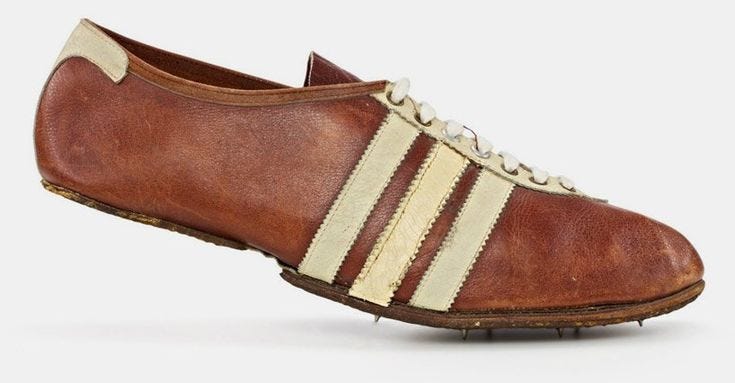
And wear them he did. He won four gold medals. The fastest man on earth, sticking a finger straight up the Nazi ideology’s backside. The footage circled the globe. Orders flooded in from places the Dasslers had never heard of, and they had just invented athlete endorsement before anyone had a name for it.
The basement where brotherhood went to die
Wars have a way of rotting things from the inside. The Dassler factory stopped making sports shoes and started churning out boots for soldiers, then tank parts, then whatever else the Wehrmacht needed. When Rudolf got drafted, Adi stayed behind to run production. And somewhere in the mess of wartime, the walls between them started to crack.
Small cracks, from living together under the same roof with two wives, too many children, too many grievances piling up in rooms that were too small for the weight they carried. Käthe, Adi’s wife, had opinions about the business and wasn’t shy about sharing them. Rudolf resented her involvement, saw conspiracy in every whispered conversation and every closed door.
Large cracks on the night the Allied bombers came. The sky lit up, the ground shook, and everyone scrambled to the basement. Adi came down the stairs, saw Rudolf and his wife already huddled in the corner, and muttered: “The dirty bastards are back again.”
He meant the planes, but Rudolf convinced himself that Adi was talking about him.
It’s almost too stupid to be the hinge of a sixty-year blood feud. A mumbled insult, half-swallowed by the sound of explosions, turned into a declaration of war. But that’s how families fracture, not with grand betrayals, but with one too many cracks that nobody bothers to patch up.
C’est la vie.
